
Released a diagnostic tool to visualize the "invisible trust" of a company.
Analyzes corporate trust structure based on data from 172 companies and academic theory
InShift合同会社

InShift LLC (Chuo-ku, Tokyo; CEO: Katsumi Kuroki), a marketing and PR consulting firm that "transforms invisible trust into management assets," has released a free "PR Diagnostic Tool" that visualizes the structure of the intangible asset of "trust" held by companies. Based on data from 172 companies and academic theory, the tool uses 14 questions to diagnose the misalignment of information scattered among public relations, sales, recruiting, and Web-based communications, and whether the company's public relations activities are structured to lead to business results.

Background of Development
In recent years, it has been pointed out that "zero click search," in which Google's AI Overviews and ChatGPT directly answer users' questions, is on the rise. According to an overseas survey*1, approximately 60% of searches are completed without a site visit, and it is believed that a similar trend is developing in Japan as well. In response to these changes, various companies are advocating measures such as "technical optimization of AI citations on the search results screen," "enhancement of nominated searches," and "dissemination of unique primary information. All of these are considered effective approaches, but they are all technical theories on the transmission side of "how to deliver information that is already organized.
However, AI does not refer to individual pages, but to the "integrity" of corporate information scattered throughout the Web. In PR, the company philosophy is discussed, in sales, the price is appealed, and in recruitment, the ease of working is emphasized. If information transmitted in different contexts by different departments is inconsistent, AI may withhold its judgment of expertise and remove the information from the recommendation. In other words, for technical optimization to work, the "what of the company, to whom, and how it communicates" must be consistent across departments before that.
1 See our column for details (https://inshift.jp/news/zero-click-search-countermeasures/)
Diagnostic Tool Overview
This tool is a self-diagnostic program that visualizes the degree to which "the structure of trust that is a precondition for communication" is in place within a company.
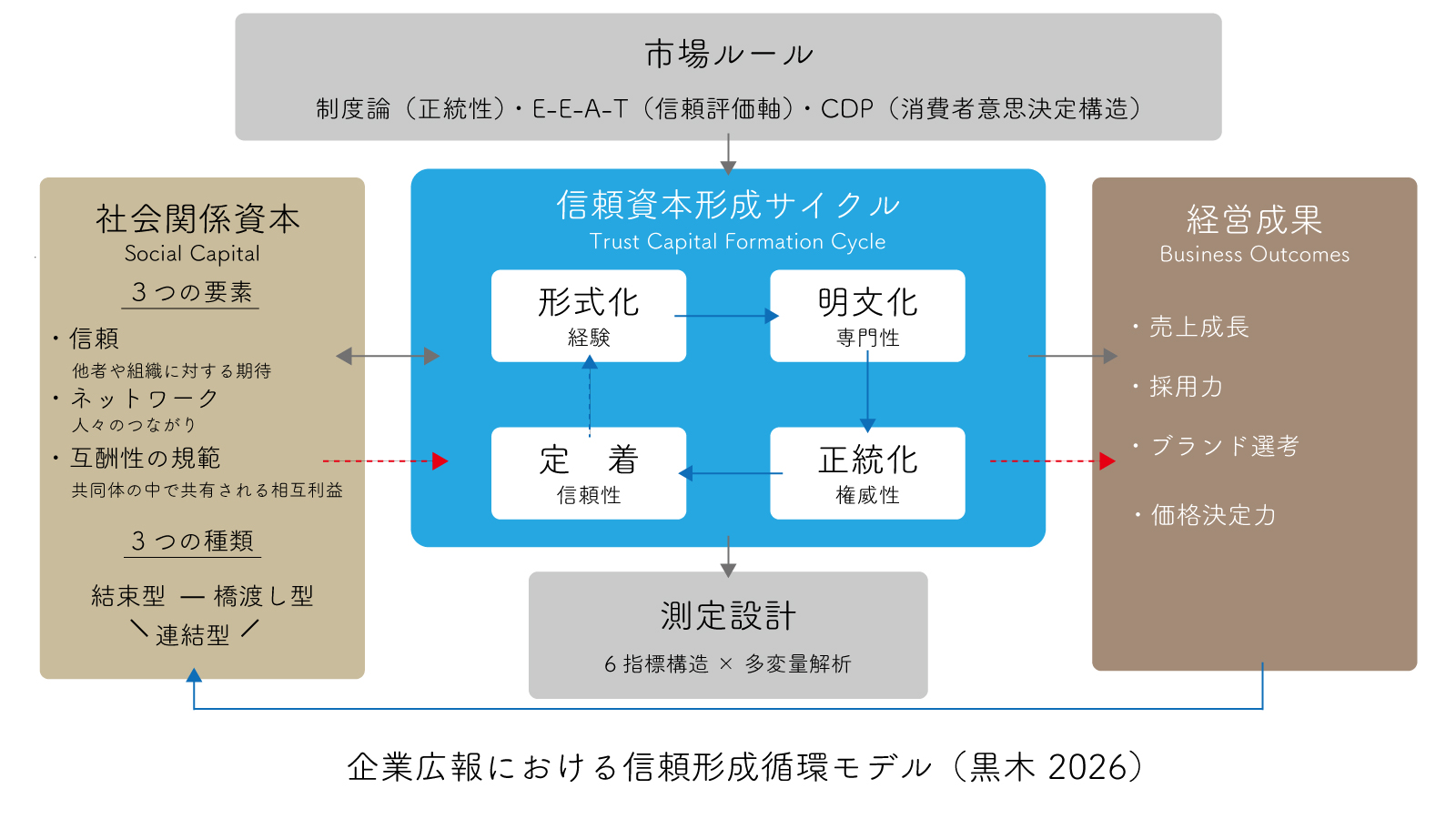
It identifies bottlenecks in the company from the following four indicators, based on the concept proposed in the book "New PR Theory in the Age of Generative AI: Horizontally Integrated Public Relations as a Corporate Survival Strategy "*2 and the "4-Stage Process Model of Trust Capitalization "*3 contributed by the Public Relations Society of Japan (Public Relations Research Journal, No. 30). 1.
Formalization: Is your company's experience and strengths verbalized as "value for customers?
2. Clarification: Are these values stored on the Web as consistent information across departments?
Legitimization: Is the company in a position to easily generate word-of-mouth and third-party evaluations?
Establishment: As a result, is the brand firmly rooted in the market as a preferred brand?
| URL | https://inshift.jp/pr-diagnosis/ |
| Time required/number of questions | Approximately 3 minutes / 14 questions (multiple choice) |
| Cost | Free of charge |
2 Book "New PR Theory in the Age of Generative AI: Horizontally Integrated Public Relations as a Corporate Survival Strategy
https://inshift.jp/bookproposal-lp/
3 Economic function and sustainability of social capital in regional business networks
〜The four-step process of trust capitalization and the mediating function of public relations
Public Relations Society of Japan (Journal of Public Relations Research, No. 30)
https://www.jsccs.jp/publishing/research/.assets/CCS30_kuroki_kitami.pdf
Contents of the Diagnostic Report
Upon completion of the diagnosis, a report on the diagnosis results will be sent immediately to your registered e-mail address. The report consists of the following three elements
1. type judgment
Based on the response data, a typology of your company's PR structure (e.g., "[Hidden Strength (Insufficient Clarity)] type," "[Promotion Ahead] type," etc.) and an overall score will be provided. You can intuitively grasp what structural issues your company is currently facing. 2.
2. score by field (converted to 100 points)
Scores are calculated on a 100-point scale for each of the six areas, including social capital and management performance, in addition to the four-step process of capitalization of trust. At a glance, you can see which areas are strengths and which areas are bottlenecks.
| A. Formalization (experience and strategy) | Is your company defined from the customer's perspective? |
| B. Clarification (expertise) | Is your company's information stored and disseminated consistently on digital media? |
| C. Legitimization (authority, third-party evaluation) | Are external evaluations such as word-of-mouth and media coverage structured? |
| D. Fixation (credibility, organization) | Is there a functioning mechanism to encourage repeat and nominated purchases by customers? |
| E. Social capital | The depth of the trust network with existing customers and the local community |
| F. Management Outcome (Sales and Brand Preference) | Are public relations activities linked to sales and brand preference? |
3. diagnostic feedback (3-stage structure)
The individual feedback generated based on the type judgment and score is composed of the following three levels. At the end of the report, one specific improvement action based on the diagnostic results is presented as an "ACTION POINT" to be taken this month.
| Current Status Analysis | Organize the strengths and challenges of the PR structure based on the scores in each area |
| 2. Inference | Estimating the structural background of issues based on gaps between fields |
| 3. Future simulation | Comparing the risk of neglect and room for improvement, and presenting next steps |
Theoretical background
The theoretical starting point of this tool is to clarify "Who and what issues does your company solve, and how?
The background of this concept is the business definition theory presented by Derek F. Abell of Harvard Business School in 1980, in which Abell considered business in three dimensions: which customers, which needs, and which technologies and capabilities satisfy those needs. In our company, this concept has been reorganized as "Who, What, and How (WWH)" in a form that is easier to use in practice. In other words, WWH is not just a way of organizing appeals, but a perspective for redefining the business itself in terms of customer value. The starting point for building trust is to verbalize the company's strengths in the customer's language (formalization) and to accumulate and disseminate them as consistent information across departments (clarification).
On the other hand, in order for a company to be recognized as "trustworthy" by the market and society, not only the content of the information itself, but also its social relevance and consistency must be accepted. In this regard, this tool is also based on the structure of how companies acquire legitimacy from the perspective of institutional theory.
Furthermore, the process by which explicit information is shared among existing customers, local communities, and human connections, and spreads as word of mouth, referrals, and empathy, can be viewed as the formation and utilization of social relational capital.
This tool is designed to visualize this process of "value definition → consistent communication → acquisition of social legitimacy → spillover and establishment of trust" as the structure of trust formation in corporate PR.
Empirical data] (under verification)
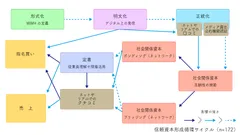
The following findings were obtained from a multivariate analysis (path analysis) of 172 small and midsize companies nationwide, in terms of the causal structure linking PR activities to management outcomes (nomination and purchase, recruiting power, and business performance). The model is currently being validated.
(1) Linkage of the "4-step process" of trust capitalization
It has been confirmed that the four-step process of verbalization (formalization) of the company's strengths, continuous information dissemination (clarification), and acquisition of third-party evaluation (legitimization) significantly contribute to fostering the "norm of reciprocity (spirit of mutual help)," which is the core of social relationship capital. 2.
(2) Network Expansion Starting from Reciprocity
We confirmed that the norm of reciprocity fostered functions as the main factor promoting network expansion in two directions: deepening of relationships with existing business partners (bonding) and new alliances with external parties (bridging).
3. the importance of "retention (institutionalization)" as a source of results
The study showed that companies in which trust through external networks is "institutionalized" into internal understanding of the company's philosophy and on-site activities, significantly improve their ability to purchase appointments, recruit, and achieve business results.
4. "Word of Mouth" Generation Mechanism
It has been shown that "good word of mouth," conventionally regarded as a direct result of public relations, is not merely the result of information dissemination, but is a secondary phenomenon that occurs as a result of a series of processes that "take root" in the organization.
About InShift, LLC.
InShift LLC provides marketing and public relations support based on academic knowledge and practical experience under the slogan "Turning Invisible Trust into Management Assets. The company advocates "Horizontally Integrated Public Relations" as a public relations strategy in the age of generative AI, and supports the sustainable growth of companies.
Image

Logo Image

- Category:
- Services